Show the working principle
We describe what moves, what blocks it and which action changes the state. Decoration comes later.
Independent ideas. Everyday starting points.
Part Tinker Puzzl is an independent information site about giving ordinary materials an unexpected mechanical job.
We begin with a familiar object: a box, a sheet, an offcut or a safely enclosed magnet. Then we ask what it can do. Can it pivot? Flex? Guide another part? Hide a catch?
That approach keeps the build understandable. You can see how one choice changes the result, and you do not need to buy an elaborate kit before finding out whether you enjoy mechanical puzzles.
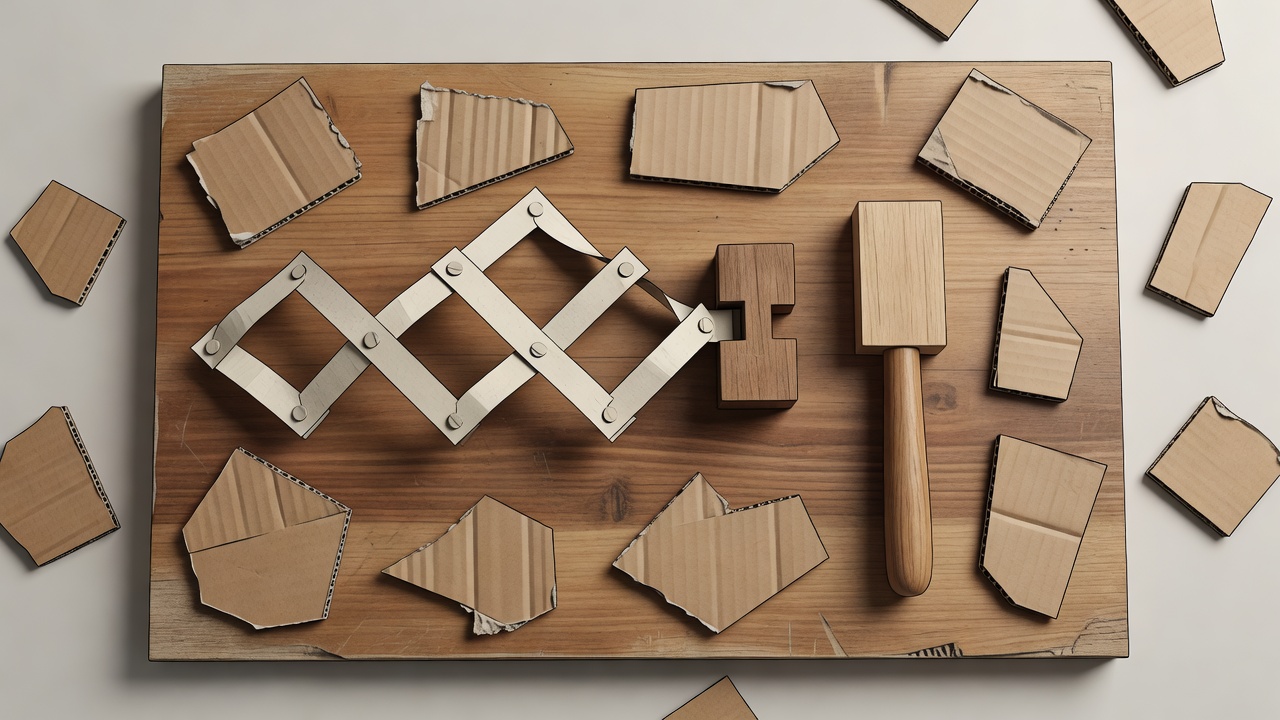
We describe what moves, what blocks it and which action changes the state. Decoration comes later.
Clearances, friction and reset order belong in the instructions. A troubleshooting note is part of the project, not an apology.
Scrap materials vary. Dimensions are starting points, not guarantees. Safety guidance does not replace tool instructions or a local risk assessment.
Mechanical puzzle culture has many useful entry points. Rube Goldberg’s drawings make cause and effect delightfully excessive. W. Heath Robinson’s imaginary contraptions offer another playful lens. Martin Gardner’s Mathematical Puzzles and Diversions and Jerry Slocum and Jack Botermans’s Puzzles Old & New explore different sides of puzzle thinking.
Henry Dudeney’s The Canterbury Puzzles and Sam Loyd’s Cyclopedia of Puzzles are historical sources for puzzle culture, not construction manuals for these projects. Robert Sabuda and David A. Carter demonstrate the possibilities of paper engineering. Arthur Ganson’s kinetic sculptures and the Exploratorium’s Tinkering Studio offer further inspiration for thinking through movement.
The Science Museum in London and The Strong National Museum of Play in Rochester provide broader contexts for invention and play. The Japan Puzzle Association and the International Puzzle Party connect with established puzzle communities. ISO 216 is useful when interpreting paper sizes; ASTM F963 and EN 71 concern toy safety, but mentioning them does not mean these homemade projects have been assessed or certified under either standard.
Make the mechanism understandable enough to repair, and surprising enough to share.
These names are reading and exploration leads. Part Tinker Puzzl is not affiliated with or endorsed by any of the people, institutions or organizations mentioned. Our project instructions are our own editorial explanations, and we do not claim that those references validate a build.
Found an ambiguous step or a measurement that needs context? Prepare a project note with the page name, your material thickness and the movement you expected. Please avoid sending private information about children or other people.