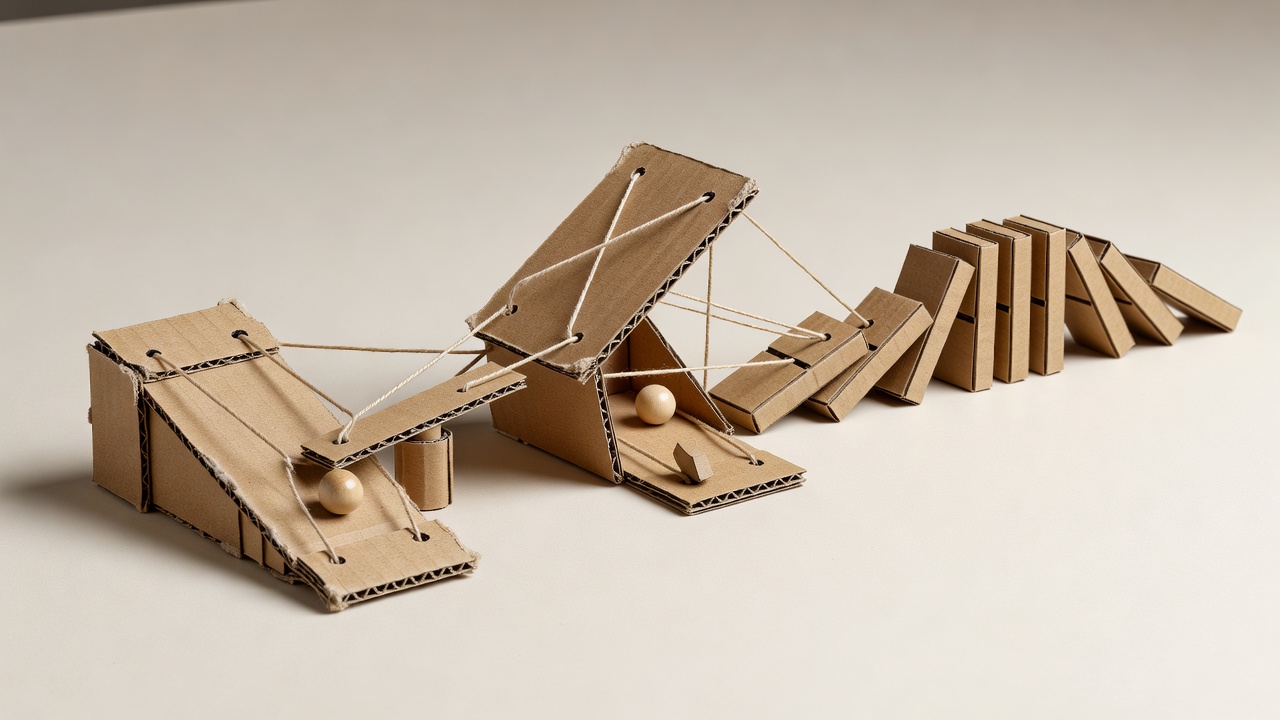
The puzzle in an empty box
The challenge is simple: release the waiting ball using only the entry ball. The entry ball rolls into a small cup on one end of a lever. That end drops, the opposite end rises, and a thread lifts a lightweight gate. A second ball, parked on another ramp, can now roll away. Nothing needs a motor, and every stage is visible enough to diagnose.
This is a small chain reaction in the spirit of Rube Goldberg’s elaborate machines, but reliability matters more than spectacle. Keep the first version short. A sequence with three dependable movements teaches more than a sprawling arrangement that needs a helpful nudge.
Rescue these materials
- A clean corrugated box for a base about 30 × 40 cm.
- A cereal carton for the lever, gate and folded ball cup.
- Two balls of similar size, approximately 25–30 mm across, plus a tray to catch them.
- A paper drinking straw, a blunt wooden skewer with its points removed, thread, tape and paper glue.
- Scissors, a ruler and a pencil. Adult-only knife work is optional, not necessary.
Ball size determines your track width. Make each track a little wider than the ball, with raised rails so it cannot escape sideways. Use clean, dry packaging without staples. Put the base on a stable table inside a larger tray; loose balls are both a trip risk and a small-part hazard.
Build the handoff, not the decoration
1. Make two gentle ramps
Fold two strips of corrugated board into shallow channels. Tape a folded-card support under the upper end of each. Begin with a modest slope: the ball should roll steadily rather than jump. Aim the first ramp at the lever cup. Place the second ramp alongside it, with its lower end leading into the catch tray.
2. Give the lever a free pivot
Laminate two carton strips into a lever roughly 16 cm long. Tape a short straw sleeve across its underside at the midpoint. Slide the blunt skewer through the sleeve and support its ends on two folded-card stands. Secure the axle ends to the stands, not to the sleeve. The lever must rotate around the axle without scraping the base.
Fold a shallow cup onto the incoming end. The first ball must remain there, keeping that end down long enough for the other ball to escape. Add a soft card stop below the lever so the cup cannot fall too far.
3. Fit a lifting gate
At the lower end of the second ramp, make two vertical guide channels from folded carton. Slide a thin gate between them. It needs to stop the ball when lowered and clear the ball completely when raised. Connect thread from the gate’s top edge to the lever’s rising end, routing it directly overhead without sharp bends.
Move the lever by hand before loading either ball. If the gate travels only a small distance, move the thread attachment farther from the pivot or lower the gate’s required lift. Make the gate lighter before making the entry ramp steeper.
4. Assemble the sequence
Lower the gate and park the second ball behind it. Balance the empty lever so its cup sits just below the entry ramp. Release the entry ball from a pencil mark on the ramp. It should settle into the cup, tilt the lever and lift the gate. Adjust the thread length until there is very little slack but no unwanted lift at rest.
Turn it into a fair challenge
Give the solver three marked starting points on the entry ramp and ask which one produces a complete release without ejecting the first ball. Offer a movable ramp support as the only adjustment. The puzzle now involves prediction and testing, not simply watching a demonstration.
Reset in the same order every time
Remove the first ball, lower the gate, check that the thread is clear, park the second ball and return the lever to its starting position. Resetting carefully makes each trial comparable.
If the gate jams halfway
Disconnect the thread and lift the gate by hand. Widen the guide channels slightly and check that both sides are parallel. Reconnect only when the gate drops freely under its own weight.
Run several trials from each starting mark and record the outcome. Do not change the ball, slope and thread length together. That habit of isolating variables is useful well beyond this cardboard machine.
Once the sequence is consistent, add an exit bell made from a loosely suspended metal lid, or replace the catch tray with another broad ramp. Stop adding stages when resetting becomes frustrating. A compact, understandable machine is a successful invention.
Prefer a quieter mechanism? Turn one sheet into a concealed paper interlock.