Choose safety before strength
Use a magnet permanently enclosed in a robust, intact handle or housing. Do not dismantle electronics, use loose neodymium discs, or rely on a thin layer of tape to contain a magnet. If you cannot provide secure containment, choose the paper mechanism project instead. A stronger magnet is not automatically a better control system.
Magnets can also interfere with implanted medical devices. Follow the device manufacturer’s separation guidance and do not use this activity around an affected person without suitable advice. Keep the wand away from magnetic storage media and sensitive equipment. Inspect its housing before and after every session.
Find the right material pairing
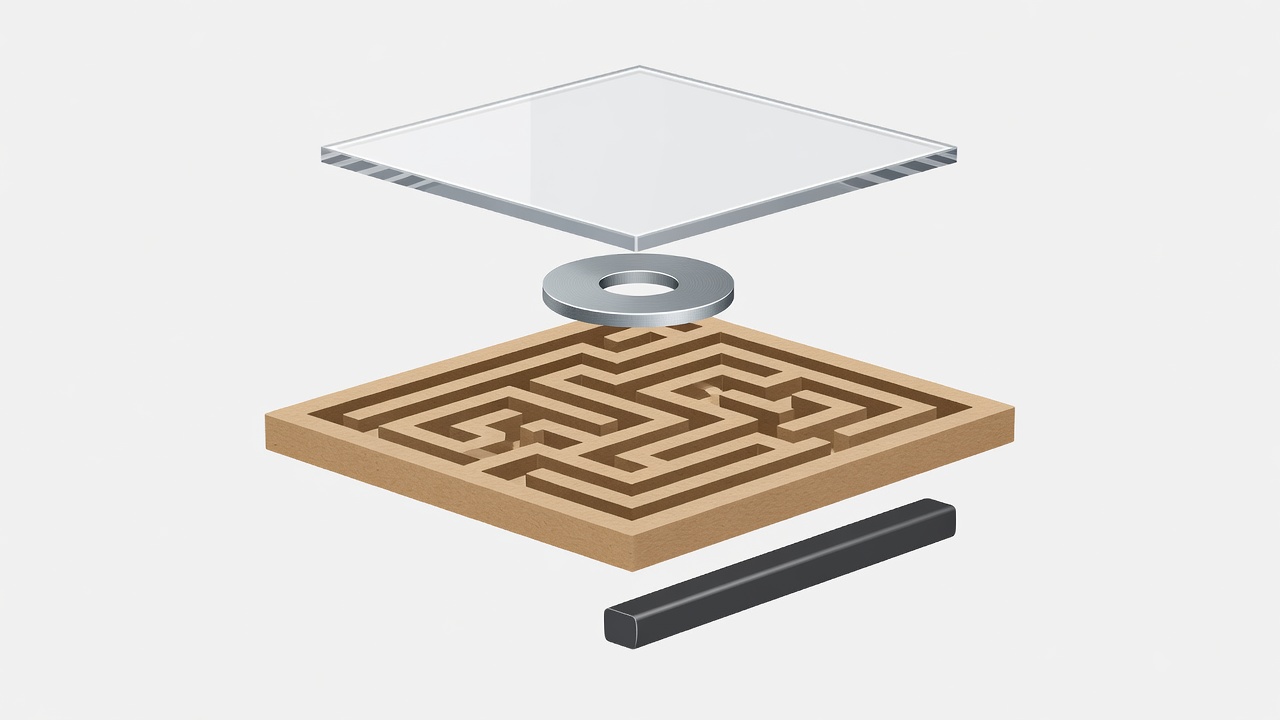
Gather a clean cereal carton, straight scrap-card strips, a large smooth steel washer, paper glue, tape, scissors and a ruler. For the cover, reuse clean, rigid, transparent packaging with no sharp edges. Use a suitably enclosed magnet in a comfortable handle. Test the washer first: some stainless steels respond weakly or not at all.
Make a base around 20 × 25 cm. Thin carton works better than thick corrugated board because magnetic attraction weakens with distance. Support the perimeter with a stiff frame so the playing area does not sag, while leaving the underside accessible to the wand. The magnet must approach the base without your fingers being pinched against nearby steel furniture.
Before adding maze walls, place the washer on the base and move the wand beneath it. Try straight lines, corners and a short pause. The washer should follow at a slow, comfortable speed. If it refuses, change the base thickness or washer before rebuilding the whole puzzle.
Build the maze around the movement
1. Draw a forgiving route
Sketch a start area, a finish and a winding path on the upper face. Make corridors at least the washer’s outside diameter plus about 6 mm. Leave generous turning spaces. Add two dead ends, but keep the first version small enough that the solver can understand the layout at a glance.
2. Raise walls that cannot be crossed
Fold card strips into L-shaped sections and glue their feet to the base along your route lines. Make every wall taller than the washer’s thickness. Once covered, the gap above the walls must be too small for the washer to climb over them. Use a consistent wall height so the cover can rest evenly.
Allow the glue to dry fully before testing. A damp glue ridge can catch the washer and create an accidental obstacle. Trim or flatten protruding joints with the washer removed from the workspace.
3. Fit the cover and capture the piece
Put the washer in the start zone. Fit the transparent cover over the perimeter frame and walls, then secure all edges so it cannot lift during ordinary play. Avoid a cover that can pop open and release the washer. Any damaged edge or loose seam means the puzzle should be taken out of use until repaired.
4. Establish a calm starting routine
Hold the frame level and bring the wand beneath the washer slowly. Move the wand a little, then wait for the piece to follow. Sudden movements can break the magnetic connection. Guide the washer to the finish and back again before offering the puzzle to someone else.
Make the invisible control part of the challenge
The basic goal is to reach the finish without tilting the board or touching the cover. Add a route card that requires visiting two marked checkpoints. Once the transparent version is reliable, place a removable paper mask over one straight section. The solver must remember the route and infer the piece’s position from what happens next.
Do not cover the entire maze at first. A fully hidden layout without clues is usually a guessing exercise. A few visible windows provide feedback while preserving the unusual experience of steering through a wall.
If the washer sticks beneath the wand
Strong attraction can increase contact friction. Try a thin nonmagnetic spacer beneath the base, keeping the magnet inside its original housing. Test gradually; too much separation makes the washer stop following.
If you want to explore magnetic polarity
Use two purpose-made, fully enclosed educational magnets under appropriate supervision. Like poles repel and unlike poles attract. Do not expect a steel washer to show the same polarity behavior: it is attracted by either pole.
After play, store the wand separately in a secure location and inspect the covered board for damage. Write down the material stack that worked: base thickness, washer type and any spacer. Those details explain more than simply labeling a magnet “strong.” For another way to transfer motion, build the cardboard lever sequence.